


Choosing a floor mat labeled “eco-friendly” sounds straightforward until you realize that term covers everything from a thin coir doormat to a heavy-duty recycled PET entrance mat engineered for 10,000 daily footsteps. For facility and property managers, that gap in performance is not a minor detail. It affects slip liability, cleaning budgets, replacement frequency, and your facility’s actual environmental footprint. This guide cuts through the marketing noise and gives you a clear, evidence-backed framework for selecting, verifying, and maintaining sustainable commercial floor mats that hold up where it counts.
Table of Contents
- Why eco-friendly floor mats matter in commercial spaces
- Types of materials: Comparing eco-friendly options
- Top eco-friendly floor mat options for high-traffic environments
- What to look for: Certifications and key standards
- Maintaining eco-friendly mats: Tips for longevity and sustainability
- Sustainable matting solutions: Take your facilities further
- Frequently asked questions
Key Takeaways
| Point | Details |
|---|---|
| Match mats to usage | Select recycled synthetics for durability in busy commercial environments and assess natural fibers only for light, dry use. |
| Check certifications | Use credible certifications to confirm sustainability claims and avoid greenwashing. |
| Support sustainability with maintenance | Daily care with appropriate cleaning products extends mat lifespans and reduces environmental impact. |
| Demand water and slip control | Prioritize mats with high water retention and certified slip resistance to support facility safety. |
Why eco-friendly floor mats matter in commercial spaces
Commercial entrances and corridors face a level of abuse that residential settings never see. Soil, moisture, oils, and heavy foot traffic combine to create slip hazards, accelerated mat wear, and frequent replacement cycles. Each replacement cycle means more material in a landfill. That is the core problem with choosing the wrong mat, even one marketed as green.
The right sustainable floor mat solutions address multiple operational goals at once. They trap debris and moisture at the entrance, reducing interior cleaning costs. They resist compression and fiber breakdown under heavy use, extending service life. And they project a facility image that aligns with corporate sustainability commitments, which matters increasingly to tenants, visitors, and auditors.
Here is what genuinely sustainable commercial mats deliver:
- Reduced landfill contribution through longer service life and recyclable materials
- Lower cleaning chemical use when mats trap soil effectively at the source
- Slip hazard reduction, cutting liability exposure in wet entry zones
- Alignment with green building certifications like LEED when products carry verified credentials
“Natural fibers like coir are biodegradable and renewable, but recycled synthetics offer superior durability for high-traffic, commercial spaces.”
Pro Tip: Before committing to any mat product, request a sample and place it in your busiest entrance for two weeks. Real-world performance data beats spec sheets every time.
When you explore eco-friendly commercial mats, prioritize products that balance material sourcing transparency with proven durability metrics, not just a green label on the packaging.
Types of materials: Comparing eco-friendly options
Not all sustainable mat materials perform equally under commercial pressure. The two primary categories are natural fibers and recycled synthetics, and each has a distinct performance profile.
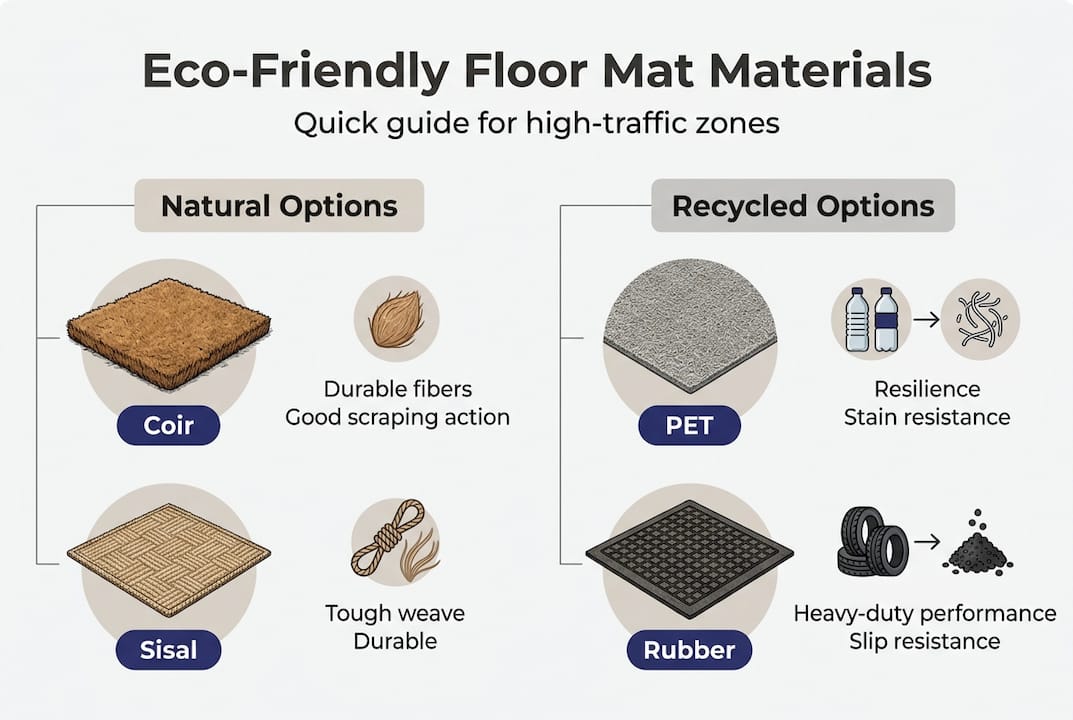
Natural fiber mats (coir, sisal, cork) score high on renewability and end-of-life biodegradability. Coir, made from coconut husks, is a genuine agricultural byproduct. These mats work well in low-to-moderate traffic areas with controlled moisture exposure. Their weakness is durability under sustained heavy use and vulnerability to mold in persistently wet conditions.
Recycled synthetic mats (PET, ECONYL, recycled rubber) are engineered for commercial performance. The WaterHog Eco series uses 100% recycled PET for the face fiber and 20% recycled tire rubber for the backing, delivering industry-leading water trapping. Grip Max Pro mats use 100% ECONYL regenerated yarn and 34% recycled nitrile rubber, combining sustainability with oil resistance.
| Material | Recycled content | Durability | Moisture resistance | Best use |
|---|---|---|---|---|
| Coir (natural) | 0% (renewable) | Moderate | Low | Low-traffic, dry entries |
| Sisal (natural) | 0% (renewable) | Moderate | Low | Interior, low-traffic |
| Recycled PET | Up to 100% | High | High | High-traffic entrances |
| ECONYL polyamide | 100% regenerated | High | High | Indoor commercial zones |
| Recycled rubber | 20-34% | Very high | Very high | Wet zones, industrial |
Pro Tip: For facilities with loading docks or kitchen service corridors, recycled rubber backing is non-negotiable. It resists oil, grease, and heavy rolling loads that would destroy natural fiber mats within weeks.
Review the full matting guide for high traffic to match material specs to your specific zone requirements. Understanding eco-friendly mat benefits by material type helps you avoid over-specifying or under-specifying for each area.
Top eco-friendly floor mat options for high-traffic environments
Two products consistently lead the field for commercial sustainability and durability credentials.
| Product | Face fiber | Backing | Recycled content | Water capacity | Guarantee |
|---|---|---|---|---|---|
| WaterHog Eco Premier | 100% recycled PET | 20% recycled tire rubber | High | 1.5 gal/sq yd | 5 years |
| Grip Max Pro | 100% ECONYL yarn | 34% recycled nitrile rubber | Very high | High | Commercial grade |
| Standard polypropylene mat | Virgin polypropylene | Virgin rubber | None | Low | 1-2 years |
The WaterHog Eco Premier’s 5-year durability guarantee is a direct operational benefit. Fewer replacements mean less waste and lower total cost of ownership. The Grip Max Pro’s oil-resistant recycled rubber backing makes it the right call for food service, healthcare, and industrial entry points.
Key features to prioritize when selecting high-traffic eco mats:
- Verified recycled content percentage, not just a general “eco” claim
- Water or moisture holding capacity measured in gallons per square yard
- Backing material composition and its resistance to oils and chemicals
- Third-party certifications confirming environmental and safety claims
- Manufacturer-stated lifespan or durability guarantee
For facilities managing multiple zones, explore durable eco-friendly mats that cover entrance, transition, and interior applications. Matching the right product to each zone is more cost-effective than applying a single mat type across your entire facility. Review sustainable mat solutions by application to build a zone-specific matting plan.
What to look for: Certifications and key standards
Green marketing claims are easy to make and hard to verify without a framework. Certifications give you an objective filter. Here are the ones that matter most for commercial mat procurement:
- GRS (Global Recycled Standard): Verifies recycled content claims through third-party auditing of the supply chain
- OEKO-TEX Standard 100: Confirms the product is free from harmful substances, relevant for indoor air quality
- GreenGuard Gold: Certifies low chemical emissions, important for schools, healthcare, and LEED-targeted buildings
- NFSI (National Floor Safety Institute): Certifies slip resistance, directly reducing liability in wet entry zones
- Cradle to Cradle: Evaluates material health, recyclability, and manufacturing practices across the product lifecycle
As noted in guidance on eco-friendly mat certifications, prioritizing GRS, OEKO-TEX, GreenGuard, NFSI, and Cradle to Cradle is the most reliable way to avoid greenwashing in mat procurement.
Slip resistance certification is not optional in commercial settings. An NFSI-certified mat in a wet entry zone is a documented risk management decision, not just a product preference.
For facilities also reviewing cleaning protocols, a guide to green cleaning detergents can help align your mat maintenance program with broader sustainability goals.
Pro Tip: Run a pilot test. Place a certified mat in your highest-traffic entrance zone for two to four weeks. Track soil capture, mat displacement, and surface condition. That data justifies procurement decisions to stakeholders far better than a product brochure.
Maintaining eco-friendly mats: Tips for longevity and sustainability
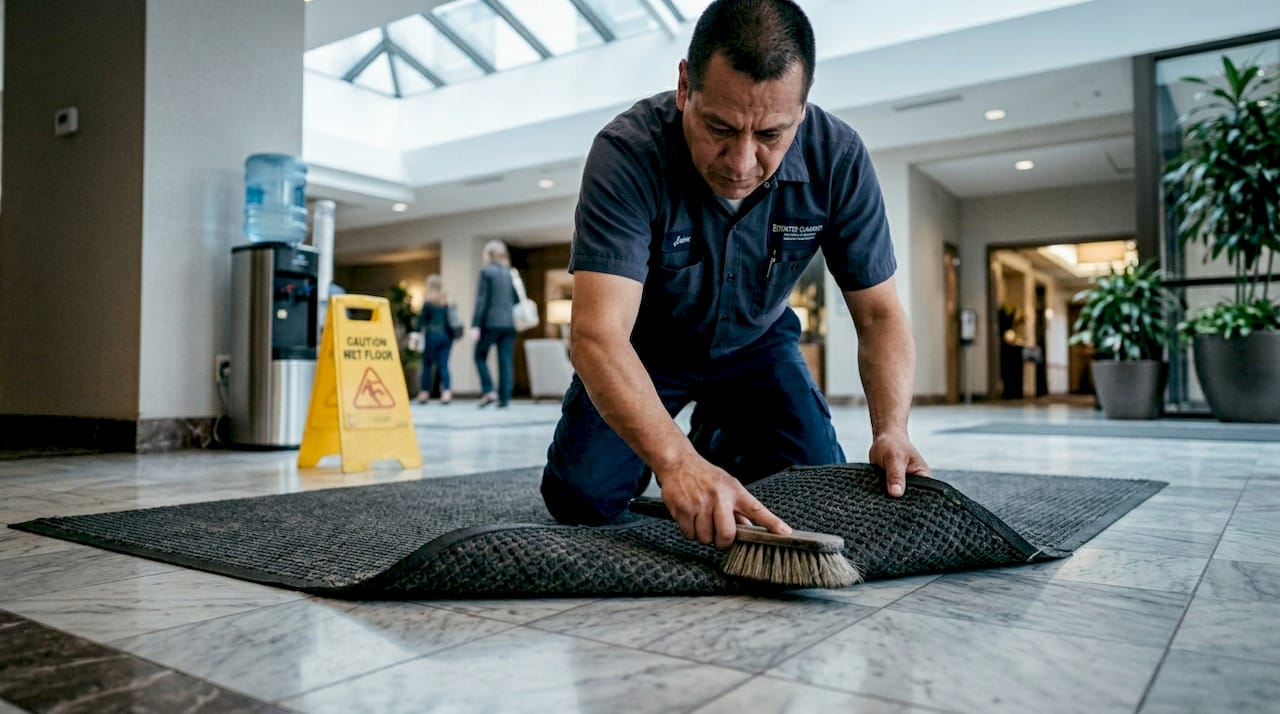
A high-quality eco mat that is poorly maintained will fail early, negating its environmental advantage. Proper care is part of the sustainability equation.
Follow these steps for recycled synthetic mats:
- Vacuum daily in high-traffic zones to prevent soil from embedding in the fiber pile
- Hose down or machine wash weekly, depending on soil load and mat size
- Use a low-pH detergent to protect fiber integrity and backing adhesion
- Hang mats to dry completely before returning them to service
- Inspect backing quarterly for cracking, curling, or delamination
For natural fiber mats, the process differs. Shake or beat them outdoors to remove dry soil. Avoid saturating coir or sisal with water, as prolonged moisture exposure causes mold and fiber breakdown. Rotate mats in wet weather seasons to allow full drying between uses.
As confirmed in Waterhog Eco Elite maintenance data, daily vacuuming and low-pH detergents extend mat lifespan and directly reduce landfill contribution by delaying replacement.
Pro Tip: In wet entry zones, never use natural fiber mats without a waterproof tray or recessed well. Trapped moisture under a coir mat creates mold within days and becomes a health and liability issue.
For a full maintenance framework aligned with durability goals, review the maintenance for durable mats resource. Consistent care protocols, documented and assigned to specific staff, are the single most effective way to extend mat service life across a multi-site facility portfolio.
Sustainable matting solutions: Take your facilities further
At Mats4U.com, the product range is built for facility and property managers who need performance and verified sustainability in the same product. From recycled PET entrance mats to ECONYL-based indoor options, every category is stocked with commercial-grade solutions that meet the certifications and durability standards covered in this guide. Whether you manage a single building or a multi-site portfolio, the right mat for each zone is available. Explore custom logo floor mats for branded entrance solutions that combine facility image with eco credentials. Browse the full range of sustainable mat solutions to find products matched to your traffic levels, zone requirements, and sustainability targets. Free delivery applies on orders over $100.
Frequently asked questions
What materials are best for eco-friendly commercial floor mats?
Recycled synthetics like PET or ECONYL and recycled rubber are best for high-traffic commercial settings due to their durability and high recycled content. Recycled synthetics consistently outperform natural fibers in moisture resistance and compression recovery under sustained commercial use.
How can I verify if a mat is truly eco-friendly?
Look for credible certifications such as GRS, OEKO-TEX, GreenGuard, or Cradle to Cradle and review recycled content claims. Certifications like GRS and NFSI are the most reliable indicators that eco claims have been independently verified.
How should eco-friendly mats be maintained in high-traffic areas?
Vacuum daily, use low-pH detergent for washing, and hang mats to dry to maximize lifespan and hygiene. Proper care including daily vacuuming directly extends mat life and reduces the frequency of replacement, lowering total waste output.
Are natural fiber mats like coir a good fit for busy entrances?
Natural fibers offer renewability but carry durability and mold risk concerns in persistently wet, high-traffic areas. Natural fibers may not withstand moisture and heavy use as effectively as recycled synthetics in commercial entrance applications.
What safety features should commercial eco-friendly mats have?
Look for NFSI-certified slip resistance, moisture containment, and anti-static properties for specialized applications. NFSI-certified slip resistance is the most direct way to document and reduce slip-and-fall liability in commercial wet zones.


