


TL;DR:
- Proper indoor and outdoor mats are essential for safety, contamination control, and floor protection.
- Correct mat placement and maintenance significantly reduce cleaning costs and slip incidents.
- Zoned, layered entry systems provide quick ROI by minimizing damage, cleaning, and liability expenses.
Choosing between indoor and outdoor matting sounds straightforward until you see the results of getting it wrong. Scratched hardwood floors, deteriorated fibers, slip incidents, and spiking cleaning costs are what happen when any mat gets dropped in any location. Facility managers and procurement specialists in high-traffic commercial spaces face real operational and financial consequences from mismatched matting. The right mat in the right zone reduces slip and fall risk, controls contamination, and protects floor surfaces. This guide breaks down the core differences, performance data, cost implications, and maintenance practices so you can make a precise, defensible purchasing decision.
Table of Contents
- Key differences between indoor and outdoor matting
- Performance: Safety and cleanliness impact
- Cost effectiveness and ROI of matting solutions
- Best practices for maintenance and longevity
- What most facilities get wrong about matting placement
- Transform your entryway with the right matting
- Frequently asked questions
Key Takeaways
| Point | Details |
|---|---|
| Match mat to environment | Using mats in their intended location improves performance and avoids costly damage. |
| Focus on system placement | Layering indoor and outdoor mats maximizes safety and minimizes cleaning needs. |
| Routine maintenance matters | Quarterly inspections and proper cleaning add years to matting lifespan and keep facilities safe. |
| ROI is measurable | Smart mat selection pays for itself fast by lowering cleaning and liability costs. |
Key differences between indoor and outdoor matting
Not every entrance faces the same threats. A covered lobby transition handles very different conditions than an exposed exterior walkway. Understanding what each mat type is engineered to do is the starting point for any sound specification.
Material composition drives the biggest distinction. Outdoor mats use rubber, PVC, and coir for weather resistance, coarse debris scraping, and water shedding. Indoor mats use nylon, microfiber, and polypropylene for absorbing moisture and trapping fine dirt and allergens. These material choices are not interchangeable. Rubber holds up under rain, UV exposure, and heavy boot traffic. Nylon and microfiber capture sub-millimeter particles that outdoor mats simply push aside.
Surface structure is equally important. Outdoor mats feature raised scraping surfaces, aggressive treads, and open grid designs that allow debris and water to fall through and away from foot contact zones. Indoor mats rely on plush pile or loop construction to capture fine particles at the fiber level. The physical design of each type directly addresses the contamination profile of its intended zone.
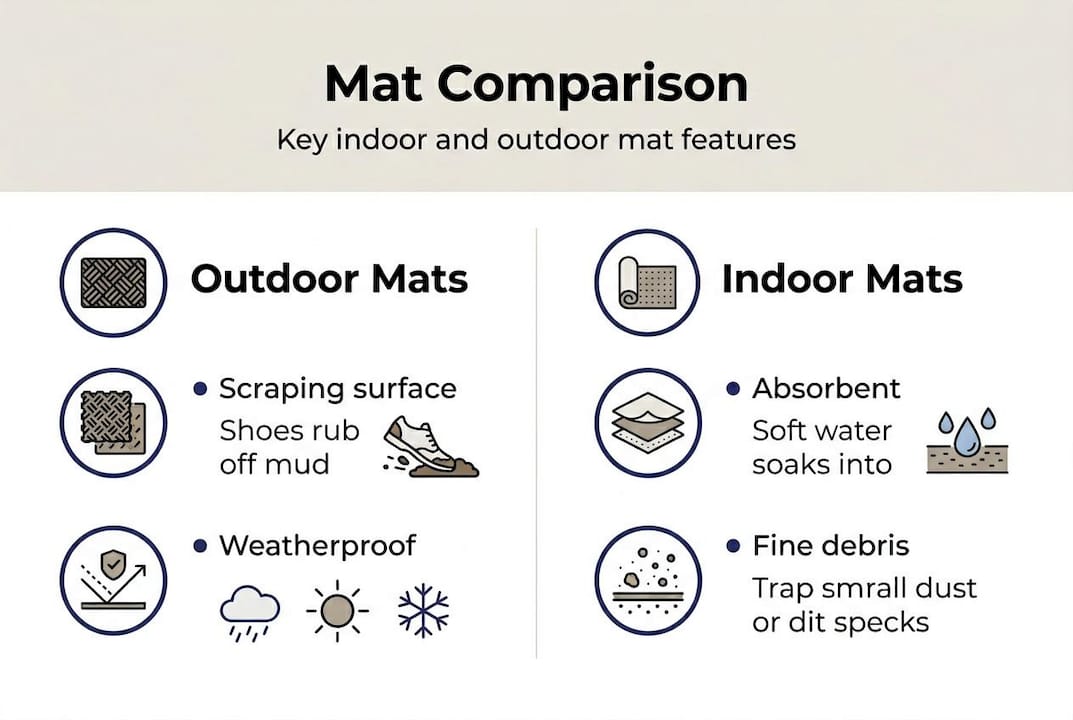
Here is a side-by-side breakdown:
| Feature | Outdoor mats | Indoor mats |
|---|---|---|
| Primary material | Rubber, PVC, coir | Nylon, microfiber, polypropylene |
| Surface design | Raised treads, open grids | Plush pile, loop construction |
| Primary function | Scrape debris, shed water | Absorb moisture, trap fine dirt |
| UV resistance | High | Low |
| Floor compatibility | Exterior surfaces | Interior flooring |
Key structural differences that matter in commercial specs:
- Drainage capability: Open grid outdoor mats prevent water pooling at entry points
- Fiber density: Indoor mats with higher pile density capture more fine particulates per square foot
- Edge treatment: Both types need beveled edges for high traffic entrance mats to prevent trip hazards
- Backing material: Outdoor mats use rubber or vinyl backings that resist moisture; indoor backings prioritize grip on finished floors
Specifying entrance matting solutions without accounting for these structural variables results in mats that wear faster, perform poorly, and require earlier replacement.
Performance: Safety and cleanliness impact
Material and structure determine capability. But how do these capabilities translate into measurable facility outcomes?
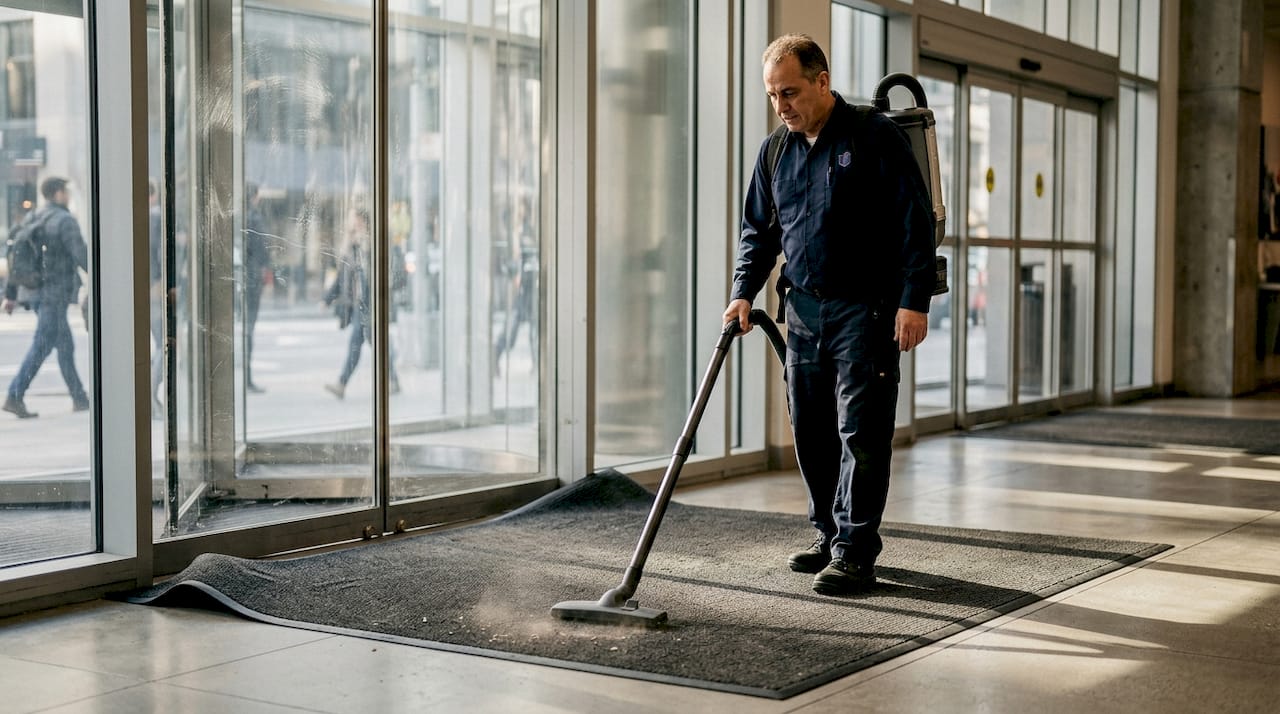
The numbers are clear. Entryway systems reduce tracked dirt and pollen by more than 80% according to Rutgers University research, improving indoor air quality. The National Floor Safety Institute reports that mats reduce slip and fall incidents by up to 50%. These are not marginal improvements. In facilities with 500 or more daily visitors, those figures translate directly into fewer incidents and lower liability exposure.
The performance gap widens when you place the wrong mat type in a zone. Using the wrong mat causes compounding problems: outdoor mats scratch and scuff interior floor surfaces, while indoor mats degrade rapidly when exposed to UV light and outdoor weather. A degraded indoor mat placed outside loses its fiber integrity within weeks, leaving it flat, saturated, and unable to capture moisture. That wet, compressed mat then becomes a slip hazard rather than a safety solution.
Matching mat type to zone is not a preference. It is a safety and performance requirement.
Practical performance considerations for facility procurement:
- Map your contamination sources: Identify whether each entry point handles coarse debris, water, or fine dust before specifying a mat type
- Layer your entryway: A scraper mat outside followed by an absorbent mat inside captures both coarse and fine contamination
- Assess UV exposure: Any mat within direct sunlight needs UV-stable materials, regardless of whether it is technically indoors or outdoors
- Check floor compatibility: Confirm that mat backing materials are rated for the floor surface they will contact
Pro Tip: For facilities with covered exterior entries that receive indirect sun, use a UV-resistant outdoor scraper mat even in semi-enclosed spaces. The protection is worth it.
For a structured breakdown of matting safety and savings at the facility level, matching mat specs to traffic volumes is the key variable. And for a direct comparison of high-traffic mat safety options, product-level spec sheets will confirm which constructions hold up under your specific load.
Cost effectiveness and ROI of matting solutions
Performance data is compelling, but procurement decisions require a financial case. The good news: the ROI on correct mat selection is measurable and fast.
Zoned matting systems pay for themselves in 6 to 12 months through reduced floor cleaning frequency and lower liability claims. When you account for the labor cost of daily mopping, the floor refinishing cycles triggered by abrasion, and the legal exposure from a single slip and fall, the upfront cost of a correctly specified mat system looks very different.
Key cost drivers to factor into your analysis:
- Cleaning labor reduction: Proper entry matting cuts floor cleaning frequency, directly reducing labor hours
- Floor refinishing cycles: Outdoor mats placed indoors scratch hard surface floors, accelerating costly refinishing schedules
- Mat replacement frequency: Mismatched mats wear out faster, increasing replacement costs over a 3 to 5 year period
- Liability exposure: A single slip and fall claim can cost tens of thousands of dollars, far exceeding the annual mat budget for most facilities
- Aesthetic maintenance: Degraded or wrong-spec mats look unprofessional and require more frequent replacement to maintain appearance standards
Pro Tip: When building a business case for a matting upgrade, calculate your current annual floor cleaning labor cost and apply an 80% dirt capture rate to estimate labor savings. That single number often justifies the investment.
Matching material selection to traffic volume and climate conditions, rather than defaulting to aesthetic choices, is what separates a cost-effective system from an expensive mistake. Review best flooring for high traffic environments for context on how mats fit into broader floor protection strategy. For specific product-level guidance, commercial entrance mat picks provide vetted options aligned with performance and durability benchmarks.
Best practices for maintenance and longevity
Selecting the right mat is step one. Keeping it performing over its full service life requires a structured maintenance approach.
Outdoor mats need more intensive cleaning methods to remove embedded debris, while indoor mats require gentler care to preserve fiber structure. Quarterly inspections in high-traffic facilities can extend mat service life from a typical 1 year up to 3 years. That lifespan difference represents a significant reduction in replacement costs over a 5 year period.
Maintenance steps for outdoor mats:
- Daily debris removal: Shake or blow out accumulated grit to prevent fiber compression and surface clogging
- Weekly pressure washing: Use low-pressure water to clear embedded particles without damaging rubber or PVC structure
- Monthly drainage check: Confirm that open grid designs are not clogged with compacted debris that blocks water flow
- Quarterly structural inspection: Check for curling edges, cracking rubber backing, and surface wear that signals replacement timing
Maintenance steps for indoor mats:
- Daily vacuuming: Use low-suction vacuums to lift fine particles without pulling pile fibers
- Spot treatment: Address spills immediately with pH-neutral cleaners to avoid fiber damage
- Bi-weekly rotation: Rotate mats to distribute wear evenly across high-contact zones
- Quarterly deep clean: Use extraction cleaning (wet vacuum method) to remove embedded allergens and restore pile loft
Pro Tip: Set a calendar-based maintenance schedule rather than a condition-based one. By the time a mat looks worn, it has already been underperforming for weeks.
For detailed protocols, maintenance tips for property managers cover scheduling and vendor coordination. The best mat maintenance practices guide addresses both indoor and outdoor specific care, and mat cleaning for business outlines practical cleaning workflows for commercial settings.
What most facilities get wrong about matting placement
The indoor vs outdoor framing leads many facility managers to think in binary terms: one mat at the door, job done. That single-mat approach is where most facilities lose performance and money.
The real issue is system design. A layered entryway, with an outdoor scraper followed by a transitional mat and then an interior absorber, captures contamination at every stage rather than letting it migrate deeper into the building. Most facilities that report high cleaning costs and recurring slip incidents are running single-mat setups in zones that demand three.
Placement logic should follow traffic flow mapping, not just entry point identification. High-transition zones like elevator lobbies, stairwell landings, and corridor intersections are as critical as front doors. Those interior zones need choosing and using indoor entrance mats that are sized and specified for their actual traffic load, not whatever was left over from the last order.
The facilities that perform best treat matting as infrastructure, not supplies.
Transform your entryway with the right matting
The right mat in the right zone reduces cleaning costs, protects floors, and cuts slip risk. Mats4U.com carries industry-leading solutions for every entry point and transition zone. The WaterHog Max Herringbone Mat delivers heavy-duty scraping and absorption performance for high-traffic entries. For interior zones where first impressions count, premium logo floor mats combine branding with function. Browse the full matting solutions catalog to find options matched to your facility’s traffic profile, climate conditions, and floor types. Free delivery on orders over $100. Made in the USA.
Frequently asked questions
How do I know if I need indoor or outdoor mats at a specific entrance?
Assess weather exposure and traffic type at each entry point. Outdoor mats handle coarse debris and weather; indoor mats are built for absorbing moisture and trapping fine dirt in covered or interior zones.
Can I use the same mat indoors and outdoors?
No. Outdoor mats scratch indoor floors and indoor mats degrade rapidly from UV exposure and weather. Always match the mat to its intended environment.
How often should commercial mats be cleaned or inspected?
At minimum, inspect and perform deep cleaning every quarter. Quarterly inspections extend mat life from 1 to 3 years in high-traffic commercial environments.
What’s the ROI of a zoned entryway matting system?
A correctly specified zoned system delivers measurable returns fast. Zoned systems pay back in 6 to 12 months through reduced cleaning labor and lower liability costs.


