


Balancing sustainability commitments with real-world safety requirements is one of the most persistent challenges for facility managers today. Slip resistance, durability under heavy foot traffic, and indoor air quality all compete with recycled content goals and end-of-life disposal plans. The good news: modern eco-friendly mats can satisfy all of these demands simultaneously, but only when you know exactly what to look for. This guide walks through certifications, material comparisons, zone-by-zone placement, and total cost of ownership so you can make purchasing decisions that hold up under both audits and daily use.
Table of Contents
- Understand certifications and standards
- Evaluate materials against real-world facility needs
- Zone-by-zone selection: matching mats to high-traffic areas
- Plan for maintenance, TCO, and long-term performance
- Why sustainable facility matting is about more than just ‘eco materials’
- Find the right eco-friendly matting solutions for your facility
- Frequently asked questions
Key Takeaways
| Point | Details |
|---|---|
| Verify certifications | Eco-friendly mat claims must be validated with trusted third-party certifications to ensure true sustainability and safety. |
| Match materials to zones | Choose mat materials based on traffic, moisture, and allergen safety for each facility area. |
| Pilot and rotate | Test and rotate mats to maximize durability and minimize waste. |
| Prioritize maintenance | Regular care and tracking reduce costs and extend mat life substantially. |
| Think system-wide | Effective eco-mat programs go beyond material choice by considering compliance, zone needs, and procurement transparency. |
Understand certifications and standards
To begin, it’s crucial to understand how genuine eco-friendly claims are verified. The commercial mat market is crowded with vague environmental language. Words like “natural,” “green,” or “sustainable” carry no legal weight without third-party verification. Certifications do the heavy lifting here.
The most credible eco-friendly certifications for commercial mats include the following:
| Certification | What it verifies |
|---|---|
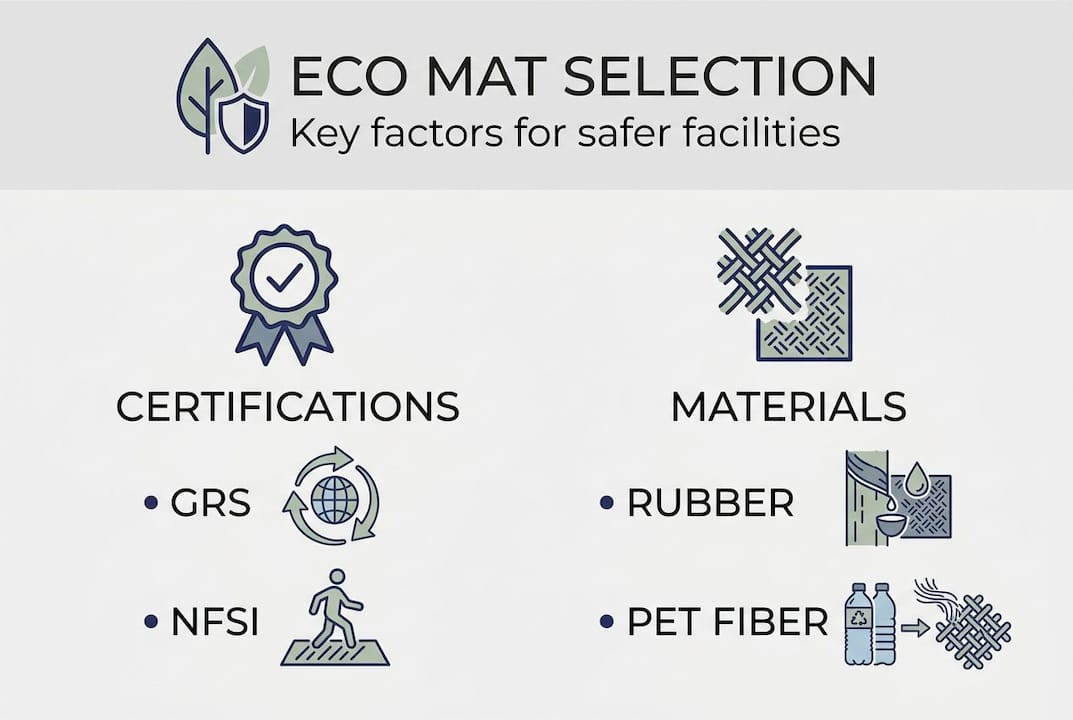
| GRS (Global Recycled Standard) | Verified recycled content percentage |
| OEKO-TEX Standard 100 | Absence of harmful chemicals in fibers |
| Green Seal | Lifecycle environmental performance |
| FloorScore | Low VOC emissions, indoor air quality |
| GreenGuard Gold | Stricter VOC limits for sensitive environments |
| NFSI (National Floor Safety Institute) | Slip resistance and traction safety |
| Cradle to Cradle | End-of-life recyclability and material health |
| LEED eligibility | Contributes to building sustainability credits |
These standards for sustainable mats are not interchangeable. A mat certified by NFSI confirms traction but says nothing about recycled content. A GRS-certified mat confirms recycled fiber but does not address emissions. You often need multiple certifications to cover all your facility’s requirements.
The Nordic Swan criteria for textile floor coverings set a useful international benchmark, covering chemical restrictions, durability, and recyclability in a single framework.
Greenwashing is common. Here’s how to separate credible claims from misleading ones:
- Credible: Certification number listed, third-party body named, documentation available on request
- Credible: LEED credit category specified (Materials and Resources, Indoor Environmental Quality)
- Misleading: “Eco-friendly” or “green” with no supporting certification
- Misleading: Brand-created seals or self-awarded ratings
- Misleading: Recycled content claimed without GRS or equivalent verification
For procurement purposes, sustainable mat solutions that carry LEED-eligible certifications can directly support your building’s rating under the Materials and Resources credit category. Always request the full certification documentation, not just a logo on a product page.
Evaluate materials against real-world facility needs
Once you’ve confirmed certifications, compare the actual materials and their suitability for your use case. Not every eco-friendly material performs equally across environments.
| Material | Durability | Maintenance | Slip safety | Recyclability |
|---|---|---|---|---|
| Recycled rubber | 5 to 7+ years | Low | High | Moderate |
| Recycled PET | 5 to 7+ years | Low | High | High |
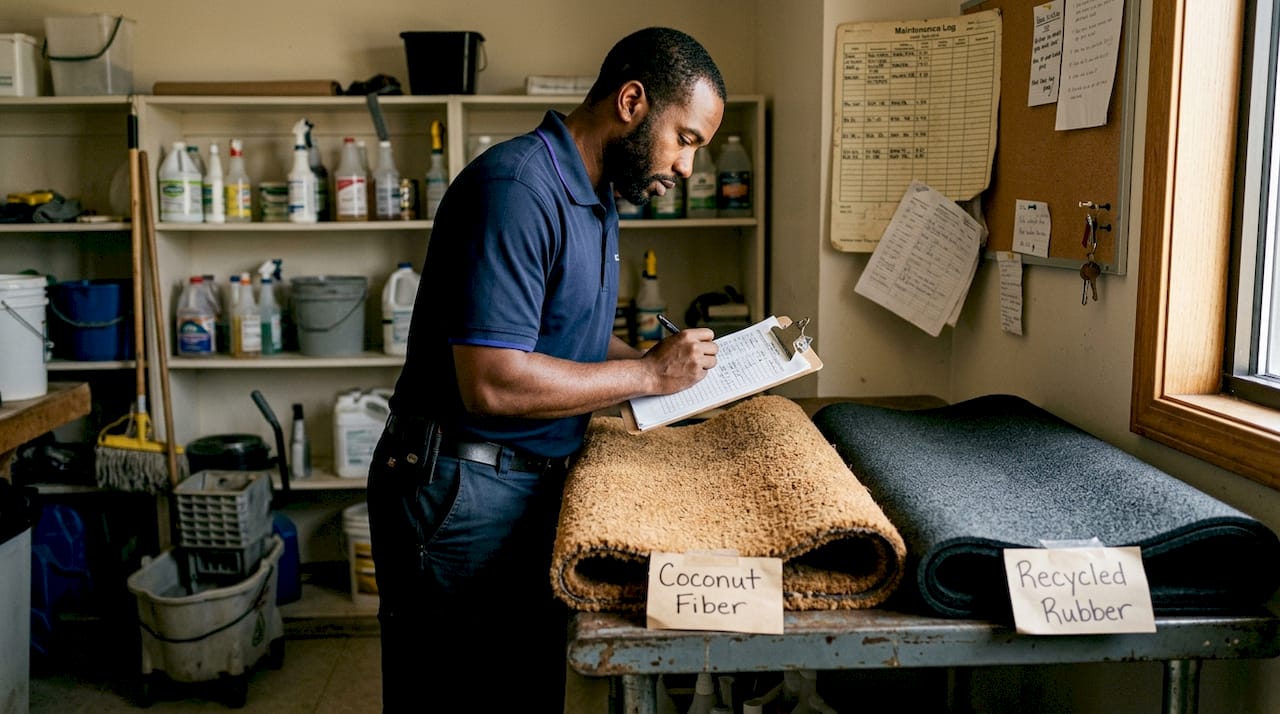
| Coir (coconut fiber) | 2 to 3 years | Moderate | Moderate | High (biodegrades) |
| Jute | 2 to 3 years | Moderate | Low to moderate | High (biodegrades) |
| Cork | 3 to 5 years | Low | Moderate | Moderate |
| TPE (thermoplastic elastomer) | 4 to 6 years | Low | High | High |
Recycled rubber and PET are highly durable and outlast virgin materials by 20 to 30 percent. Natural fibers like coir biodegrade but have a 2 to 3 year lifespan in high traffic and can develop mold in wet entry zones. For most commercial facilities, recycled synthetics are the default-best choice.
For dry interior zones with moderate foot traffic, coir and jute remain viable. They biodegrade fully, require no synthetic processing, and perform well in lobbies that stay dry. The trade-off is lifespan and mold risk.
Safety note: Coir and latex can trigger allergen issues in public-facing spaces. TPE and cork are safer hypoallergenic alternatives for healthcare facilities, schools, or any environment with vulnerable occupants.
Choose your material based on these factors:
- High traffic, wet entries: Recycled rubber or recycled PET
- Dry interior zones, moderate traffic: Coir or jute
- Healthcare or allergy-sensitive spaces: TPE or cork
- Anti-fatigue workstations: TPE with GreenGuard Gold certification
- Brand-visible areas: Recycled PET with custom logo options
Pro Tip: Ask suppliers for an EPD (Environmental Product Declaration) or LCA (Life Cycle Assessment) report. These documents quantify environmental impact from raw material extraction through disposal, giving you verifiable data for your sustainability reporting. A mat durability guide can help you cross-reference these specs against your facility’s traffic data.
Zone-by-zone selection: matching mats to high-traffic areas
Now apply your material and certification knowledge to laying out the right mats in the right locations. A single mat type cannot serve every zone effectively.
The 3-zone system is the industry standard: a scraper mat outside, an absorber mat in the vestibule, and a wiper mat inside. Rotation across zones extends mat life by 30 to 40 percent.
Here’s how to set up each zone:
- Outdoor scraper zone: Place a heavy-duty recycled rubber mat directly outside the entrance. It removes coarse debris and handles weather exposure. Look for NFSI certification and a beveled edge for entrance mat safety.
- Vestibule absorber zone: Use a recycled PET or Waterhog-style mat in the transition area. This zone captures moisture and fine particles before they reach interior flooring. Confirm ADA floor mat compliance for thickness and edge profile.
- Interior wiper zone: Deploy a low-pile recycled fiber mat that captures remaining dust and moisture. This mat protects interior floors and contributes to indoor air quality scores.
After installation, pilot test mats in each zone for 2 to 4 weeks. Track dirt retention, edge wear, and surface condition. This data tells you whether you’ve matched the right product to the right zone before committing to a full-facility order.
Rotate mats every month. Moving outdoor mats to the vestibule and cycling interior mats through cleaning extends total mat lifespan by up to 40 percent, cutting both replacement costs and landfill waste. Pair rotation with anti-slip matting specifications to maintain traction ratings across the full rotation cycle.
Pro Tip: Keep a simple log of each mat’s placement date, cleaning date, and condition rating. This record supports procurement decisions and gives you data for vendor negotiations and sustainability audits.
Plan for maintenance, TCO, and long-term performance
After selecting and installing mats, proper care and cost planning make your sustainability strategy last. The most eco-friendly mat becomes waste faster than necessary without a structured maintenance routine.
A standard care routine covers three steps: vacuum weekly to remove embedded debris, deep clean as needed using low-pH cleaners that won’t degrade fiber or backing, and always allow full drying before returning mats to service. Vacuum weekly, use low-pH cleaners, and allow full dry time. Machine-washable mats are preferred for high-rotation environments because they reduce labor and maintain consistent hygiene.
Poor maintenance shortens mat life and increases waste. Common causes include:
- Returning mats to service while still damp, which accelerates mold and fiber breakdown
- Using high-pH or bleach-based cleaners that degrade recycled rubber backing
- Skipping weekly vacuuming, allowing debris to grind down fiber
- Ignoring edge wear until the mat becomes a trip hazard
- Failing to rotate mats, concentrating wear on one area
Total cost of ownership: Sustainable mats with a 5 to 7 year lifespan often cost less over that period than cheaper alternatives replaced every 12 to 18 months. Factor in purchase price, expected replacement cycles, cleaning labor, and disposal costs before comparing options.
Request supplier transparency on all of these figures. EPD or LCA disclosures give you the data needed to calculate true lifecycle cost, not just unit price. Review your mat maintenance tips schedule quarterly and adjust orders based on actual wear data.
Pro Tip: Build a simple spreadsheet tracking unit cost, expected lifespan, annual cleaning labor, and disposal cost per mat. Run the numbers over 5 years. The results almost always favor certified, durable eco-mats over budget alternatives.
Why sustainable facility matting is about more than just ‘eco materials’
With a full plan in place, here’s a perspective on making sustainable mats truly effective for your facility. Many organizations make the same mistake: they source a mat with recycled content, check the sustainability box, and move on. The mat underperforms, gets replaced in 18 months, and generates more waste than the product it replaced.
Real sustainability in facility matting is a system-level decision. It starts with how mats are used, where they’re placed, how they’re maintained, and how performance is tracked. The material is one input, not the whole answer.
The best-performing facilities we see treat mat procurement like any other safety-critical purchase. They run pilots. They track data. They involve stakeholders from facilities, safety, and procurement in the decision. They review performance quarterly.
Modern eco-mats often surpass legacy products in both safety ratings and durability. But that advantage only shows up when deployment is deliberate. A certified mat placed in the wrong zone, cleaned with the wrong product, or never rotated will fail faster than a conventional mat managed well. The shift from “buy green” to “deploy green systematically” is where real sustainability gains happen.
Find the right eco-friendly matting solutions for your facility
To put this plan into action, explore proven, certified sustainable mats fit for your facility’s needs. The WaterHog Max Herringbone Mat is a field-proven option for high-traffic entries, built with recycled content and engineered for moisture control. For branded interior zones, premium custom floor mats combine visual impact with durable, certified materials. Anti-fatigue workstations benefit from the Comfort Premier anti-fatigue mat, designed for extended standing comfort. Contact Mats4U’s team for tailored recommendations based on your facility’s traffic zones, compliance requirements, and sustainability targets.
Frequently asked questions
What is the most durable eco-friendly mat material for commercial entrances?
Recycled rubber and PET mats are generally the most durable, lasting 5 to 7 years in high-traffic areas and outperforming virgin materials by 20 to 30 percent.
Do eco-friendly mats qualify for LEED certification points?
Yes, mats with recognized certifications support LEED eligibility under materials and indoor environmental quality credits, depending on the specific certification held.
How do I avoid greenwashing when purchasing eco-friendly mats?
Always request third-party certifications like GRS, Green Seal, or FloorScore, and verify against published Nordic Swan criteria or equivalent standards with supporting documentation from the supplier.
Is machine-washability important for sustainable matting?
Yes, machine-washable mats are easier to maintain, reduce cleaning labor, and extend mat life by keeping fibers clean and effective longer.
What is the best maintenance routine for commercial eco mats?
Vacuum weekly, use low-pH cleaners, and always fully dry mats before returning them to service to prevent mold and fiber breakdown.


