


TL;DR:
- Properly selected and maintained mats reduce workplace injuries and recurring replacement costs.
- Matching mat materials and features to specific zones ensures safety, durability, and performance.
- Purchasing high-quality mats offers better long-term value and consistency compared to rentals.
Wrong mats cost facilities more than most procurement officers realize. Slips, trips, and falls account for a significant share of workplace injuries, and improper subfloor prep causes 30% of slips in industrial environments alone. Beyond safety, poorly chosen mats wear out fast, trap less dirt, and create recurring replacement costs that drain budgets. This guide walks you through every stage of the industrial mat buying process, from assessing your facility’s specific hazards to installation and ongoing maintenance, so you can make decisions that protect your people, your floors, and your bottom line.
Table of Contents
- Understand your facility’s unique matting needs
- Match mat materials and features to each area
- Decide: Buy vs. rent mats for your business
- Install and maintain industrial mats for maximum ROI
- The hidden ROI of investing in the right mats
- Outfit your facility with proven industrial mat solutions
- Frequently asked questions
Key Takeaways
| Point | Details |
|---|---|
| Assess facility needs | Identify unique traffic patterns and hazards to determine your industrial matting requirements. |
| Choose the right materials | Match mat material, features, and certifications to specific facility zones for safety and ROI. |
| Buy vs. rent | Purchasing mats usually yields better long-term value, especially for stable businesses with high traffic. |
| Follow install best practices | Prep subfloors, measure accurately, and inspect regularly to maximize mat lifespan and effectiveness. |
| Consider branding impact | Logo mats can enhance facility image and staff morale alongside safety and cleanliness. |
Understand your facility’s unique matting needs
Before you place a single order, map out every zone in your facility and identify what each one demands from a mat. Not all areas share the same risks, and treating them the same way leads to underperformance and premature wear.
Start with your entrance zones. A 15-ft 3-zone entrance system traps up to 90% of dirt and moisture, compared to just 30% for a standard 3x5 mat. That gap directly affects how clean your facility stays and how often your floors need servicing. Entrance mats are not a place to cut corners.
Next, evaluate interior zones by hazard type:
- High-traffic corridors: Need durable, low-profile mats with beveled edges to prevent tripping.
- Wet or wash-down areas: Require drainage holes and slip-certified surfaces.
- Forklift lanes: Demand load-rated mats that can handle repeated heavy vehicle passes without deforming.
- ESD (electrostatic discharge) zones: Require certified anti-static mats to protect sensitive equipment and personnel.
- Workstations: Benefit most from anti-fatigue matting to reduce strain during long standing shifts.
Compliance is non-negotiable. Look for mats rated by the National Floor Safety Institute (NFSI) or carrying R-ratings (R9 through R13) for wet environments. These certifications confirm that a mat meets measurable slip-resistance benchmarks, not just manufacturer claims.
| Zone | Primary hazard | Mat type needed |
|---|---|---|
| Main entrance | Dirt, moisture | 3-zone entrance system |
| Wet processing area | Slips, drainage | Drainage mat, slip-rated |
| Forklift lane | Load stress | Heavy-duty load-rated mat |
| ESD workstation | Static discharge | Certified anti-static mat |
| Assembly line | Fatigue, strain | Anti-fatigue mat |
For guidance on choosing anti-fatigue mats by zone, or to review options for non-slip matting for safety, those resources break down specifications by application type. Document your zone map before moving to material selection.
Match mat materials and features to each area
Once your zone map is complete, material selection becomes straightforward. Each mat material has a defined performance profile, and matching it to the environment prevents early failure.
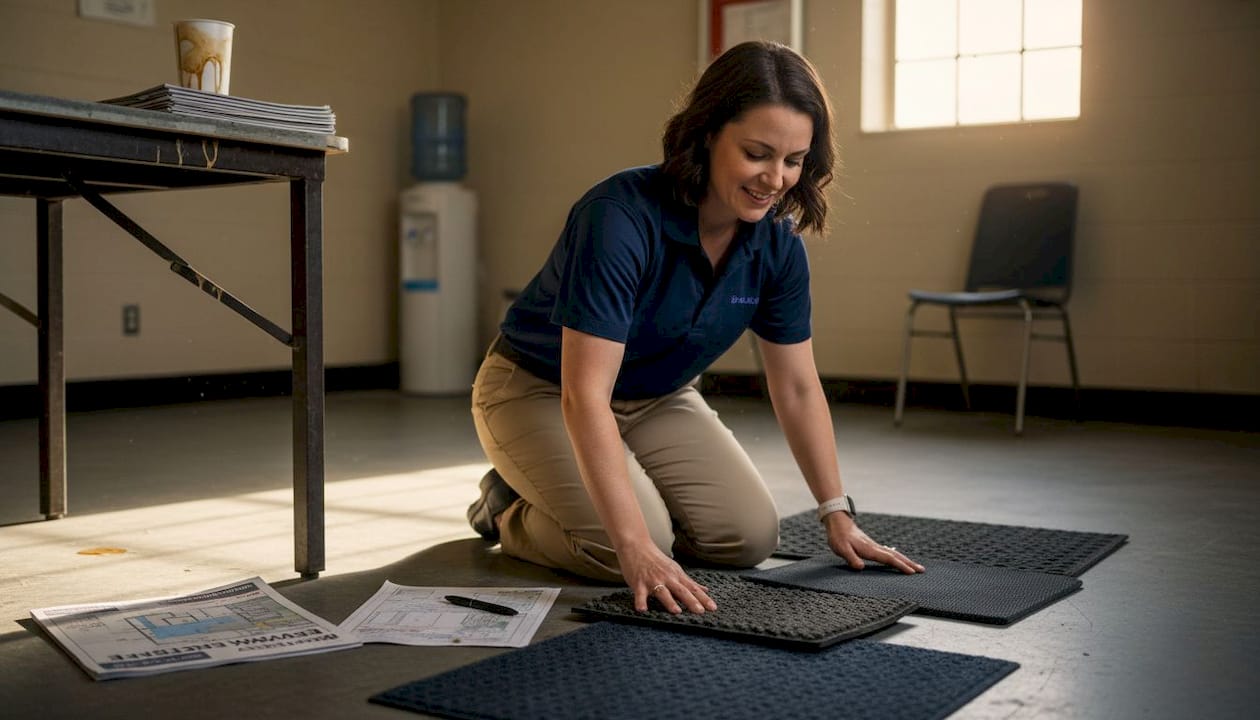
Here is how the main materials compare:
| Material | Best environment | Key advantage |
|---|---|---|
| Nitrile rubber | Oily, greasy areas | Chemical and oil resistance |
| Polyurethane | Dry workstations | Lightweight, cushioned support |
| PVC | Wet zones | Drainage, easy cleaning |
| Carpet/Berber | Entrances, offices | Dirt scraping, appearance |
Nitrile rubber mats excel in oily or greasy environments, while polyurethane suits dry areas where cushioning is the priority. For anti-fatigue applications, the thickness sweet spot is 3/8 to 5/8 inch. Thinner mats compress too quickly under load; thicker ones can create a tripping hazard or reduce stability.
Key safety features to verify before purchasing:
- Beveled edges: Reduce trip risk at mat perimeters, especially in high-foot-traffic lanes.
- Drainage holes: Essential for wet zones to prevent water pooling under the mat surface.
- Certified slip ratings: Look for NFSI certification or R-ratings matched to the zone’s wet/dry conditions.
- Rebound quality: For anti-fatigue mats, press the mat firmly and release. It should return to shape within seconds. Slow rebound means the foam core has degraded.
Pro Tip: Do not rely on thickness alone to judge anti-fatigue performance. A 3/4-inch mat with poor rebound delivers less support than a quality 1/2-inch mat. Always test samples in the actual work zone before committing to a full order.
Rubber mats last 10+ years with heavy use, making them a strong long-term investment for industrial environments. Pair that durability with the right surface texture and you reduce both injury risk and replacement frequency significantly.
For workers who stand for extended periods, review standing mats for comfort to identify the right anti-fatigue specification. And for any area where traction is critical, industrial non-slip mats provide the certified grip levels required by safety standards.
Decide: Buy vs. rent mats for your business
The sourcing decision is where many facilities leave money on the table. Rental programs look convenient upfront, but the math often favors purchasing, especially for stable, high-traffic operations.
Here is a direct comparison:
Reasons to purchase:
- Full control over mat quality, material, and specifications
- Custom branding options, including logo mats, are only available through purchase
- Lower total cost over a 3 to 5-year period
- No dependency on a vendor’s rotation schedule or hygiene standards
- Purchased mats last 5+ years and support customization that rentals cannot match
Reasons to rent:
- Useful for short-term projects, seasonal facilities, or locations with unpredictable traffic
- Vendor handles laundering and replacement
- Lower upfront cost
“Quality control and ROI favor purchasing for stable facilities. Rental services introduce variability in mat condition and hygiene that purchasing eliminates entirely.”
The hidden cost of rentals is consistency. Rental mats rotate through multiple facilities, and the condition you receive on any given week is not guaranteed. For a facility where safety and brand image matter, that variability is a real operational risk.
Pro Tip: Calculate your 5-year cost for both options. Take the annual rental fee, multiply by five, and compare it to the purchase price of equivalent mats. In most stable facilities, purchasing breaks even by year two or three and delivers savings every year after.
For a detailed breakdown of how to calculate savings with matting solutions, that resource provides a practical framework for procurement decisions.
Install and maintain industrial mats for maximum ROI
Even the best mat underperforms if it is installed incorrectly or neglected after placement. Installation quality and maintenance discipline are what separate a mat that lasts a decade from one that fails in 18 months.
Follow this installation sequence:
- Inspect the subfloor. Remove debris, check for moisture, and confirm the surface is level. Uneven subfloors cause mat edges to lift, creating trip hazards immediately.
- Measure coverage accurately. Undersized mats leave gaps; oversized mats buckle. Measure each zone precisely and order to fit.
- Secure the mat. Use adhesive tape, gripper backing, or recessed frames depending on the mat type and traffic level. High-forklift zones need recessed or anchored solutions.
- Test placement before finalizing. Walk the mat, check edges, and confirm no movement under load.
- Schedule monthly inspections. Proper subfloor prep and monthly inspections prevent 80% of contamination problems before they become safety incidents.
For complex layouts or areas with irregular dimensions, consider modular mat systems that support custom configurations and allow individual sections to be replaced without pulling the entire mat field.
“A mat that shifts underfoot is more dangerous than no mat at all. Secure installation is not optional in industrial settings.”
Pro Tip: Keep a simple inspection log for each mat zone. Note the date, condition, and any corrective action taken. This documentation supports safety audits and helps you identify which zones wear fastest so you can adjust your replacement budget accordingly.
For a complete set of facility safety and comfort tips covering installation, cleaning, and replacement cycles, that resource covers the full maintenance lifecycle in practical terms.
The hidden ROI of investing in the right mats
Most procurement conversations focus on price per mat and replacement frequency. That is the right starting point, but it misses a significant portion of the total return.
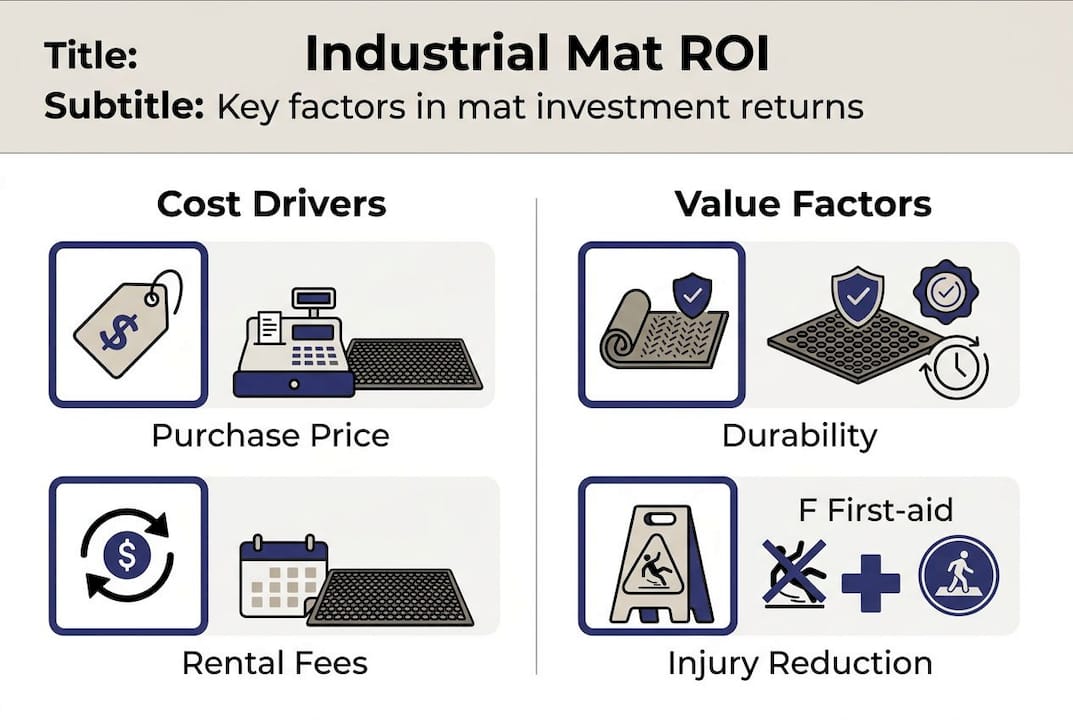
Well-chosen, slip-certified mats reduce accident rates, which directly lowers workers’ compensation claims, lost-time incidents, and the administrative burden that follows each injury. Those savings rarely appear in a mat budget line, but they are real and measurable.
What most facilities overlook entirely is the branding dimension. Customized matting reinforces branding in ways that affect customer perception and employee pride. A logo mat at your entrance signals professionalism and attention to detail before a visitor takes a second step inside.
For procurement officers, the practical takeaway is this: test samples in your highest-risk zones before committing to volume orders. Performance and visual presentation both matter. A mat that looks good but fails a wet-traction test is a liability. A mat that passes safety tests but looks worn and faded undermines your facility’s image. The right mat delivers on both dimensions, and using logo mats for branding is one of the most cost-effective ways to achieve that dual purpose.
Outfit your facility with proven industrial mat solutions
When you’re ready to upgrade your facility’s safety, comfort, and image, the right products are straightforward to find. Start with Comfort Premier anti-fatigue mats for workstations where standing fatigue is a daily issue. For entrances and reception areas where brand image matters, premium custom logo mats combine certified performance with professional presentation. If you need to cover multiple zones across a large facility, browse the full range of industrial matting at Mats4U.com, where all products ship free on orders over $100 and are Made in the USA. Use the category tools and product filters to match specifications to each zone identified in your facility assessment.
Frequently asked questions
What are NFSI or R-rated mats and why do they matter?
NFSI B101.1 and R9-R13 ramp ratings are industry benchmarks for slip resistance, certifying that a mat meets measurable safety thresholds. Specifying certified mats protects your facility from compliance gaps and reduces accident liability.
How often should industrial mats be inspected or replaced?
Inspect mats monthly for wear, curling edges, and surface contamination. Monthly checks prevent 80% of mat contamination problems, and replacement should follow any failed safety test or visible structural degradation.
Is buying or renting mats better for most facilities?
For most stable, high-traffic facilities, buying delivers better long-term ROI, consistent quality, and full customization control. Purchasing mats lowers long-term costs compared to rental programs, which add variability and ongoing fees.
What is the ideal mat thickness for industrial areas?
Anti-fatigue mats perform best in the 3/8 to 5/8 inch range for industrial workstations. Within that range, rebound quality matters more than raw thickness when evaluating long-term support and durability.


